"The niche is taken" is almost never a reason to stay out: a taken niche is proven demand. What to check before you film, what actually kills a niche, and why on Facebook the audience market counts for more than the topic you pick.
Short answer
The topic you pick counts for less than people assume, and the market you pick counts for more. The same content in different audience languages produces rate differences of tens of times over. We have never seen a spread of that size between topics.
So the question “which niche should I take” is almost always asking about the wrong thing. The right order is this:
a niche is a demand hypothesis, and you test it before filming, in one evening;
“the niche is taken” is almost never a reason to stay out. A taken niche is a niche with proven demand, while an empty one usually means there is no money in it;
what kills a niche is not competition, but a cheap market, a format you cannot repeat, and content you cannot make your own.
Four checks before you film
All four can be done in one evening without shooting anything.
1. Are there young channels with views. Look for channels under a year old in the topic. If they exist and are growing, the door is open. If everyone growing is three years old or more, you are not entering a niche — you are entering somebody’s accumulated audience, which is a different job.
2. Does demand hold, or was it a spike. A topic that took off a month ago may be over by the time you get going. Check whether interest has lived for at least a year, not just right now.
3. You will do this a hundred times. Not ten. A niche where you have ten ideas is not a niche, it is a series. It shows around the twelfth video, and then you start again from zero.
4. Who pays for this audience. The most skipped question and the one that decides the money. An audience can be large and cheap at the same time: nobody advertises to it. The views will come; the money will not.
The fourth check matters more than the first three together, and the rest of this piece explains why.
“The niche is taken” is not a stop
The most common reason not to start, and the weakest one.
A taken niche is a niche where demand has already been proven with someone else’s money. Somebody filmed it, somebody watched it, somebody paid. You do not need to establish that demand exists — it is in front of you. You need to take a percentage, not create a market.
An empty niche looks tempting right up to the moment you discover why it is empty. The reasons are usually three: there is no money in it, it has been tried and did not work, or the rules do not allow it.
There are only four real reasons to stay out:
Stop
What it means
A legal ban
the topic sits in restricted categories or cannot be monetized
Dead economics for everyone
it is not just bad for you — it is bad for everyone in the topic, the big ones included
A closed route to the audience
you can only reach them through someone who will not let you in
Demand is gone
the topic existed, the audience moved on
If none of the four applies, “taken” is not an answer. It is a description of a market worth entering.
What actually kills a niche
A cheap audience market. The topic can be excellent while the viewer sits in a country where a thousand views pay pennies. Quality does not fix this: the rate is set by who is watching, not by how well it was shot.
A format you cannot repeat. If every video needs a trip, a shooting day or a rare guest, the niche runs out before you do. What survives are formats you can reproduce at a desk.
One advertiser for the whole topic. If a single category of business pays for that audience, you are tied to its season and its budget.
Content you cannot make your own. A niche where everyone works on other people’s footage is a niche with a built-in rejection. On both platforms review asks what you added, not how neatly you assembled it. Covered in unoriginal content.
“Won’t this be called AI slop?”
A question asked about half of all topics, and its wording gets in the way.
Review looks at what the human added, not at whether AI was involved. A video assembled from other people’s clips with a synthetic voice reads as somebody else’s content — not because of the AI, but because there is nothing of yours in it. The same AI used as a tool inside your own work raises no questions.
The practical line is simple: if your video is indistinguishable from a hundred others made the same way, the problem is not the AI, it is that you did what everyone else did. That is what gets caught. More in AI videos and monetization.
On Facebook the topic counts for even less
Two further properties apply here, and both shift the weight away from the topic.
Distribution is a tournament. From what we observe, the platform picks a winner inside a topic and pours impressions into it, while everyone else in the same niche gets almost nothing. So “entering a niche” is not a sufficient goal on Facebook: you have to be the best material in it, not another one.
Originality counts for more than the topic. One video lives on one page: a copy on a second reads as a duplicate, and the one that sinks is the stronger of the two. A strategy of “the same topic across five pages” cannot work here in principle.
And above all, language. On Facebook the language of the content sets the audience’s country, and the country sets the rate. That is the fourth check from above — only with a measurable answer.
What this is worth in money
Let us be honest about what we measure and what we do not.
We measure the rate by language and by format. By language the spread across our pages is 53 times over: the open part runs from Russian at $0.014 per thousand to German at $0.163. Our measured rate on qualified views is $0.08 to $0.33 per thousand, averaging $0.185.
We do not run that measurement by topic, and it is more honest to say so plainly: we do not know how much the choice of topic is worth. We do know what the market is worth, and that figure has been measured.
Which gives this piece its conclusion. A creator spends weeks choosing a topic — a decision whose effect nobody has measured. And leaves the audience language untouched — a decision whose effect is measured in tens of times over. Because the first is within reach and the second is not: entering an expensive market takes a page that already stands in it.
EXPERIENCE AND FIGURES
≈250pages in the network
25languages
$21 216best month on one page
$4 163best day on one page
$409best single post
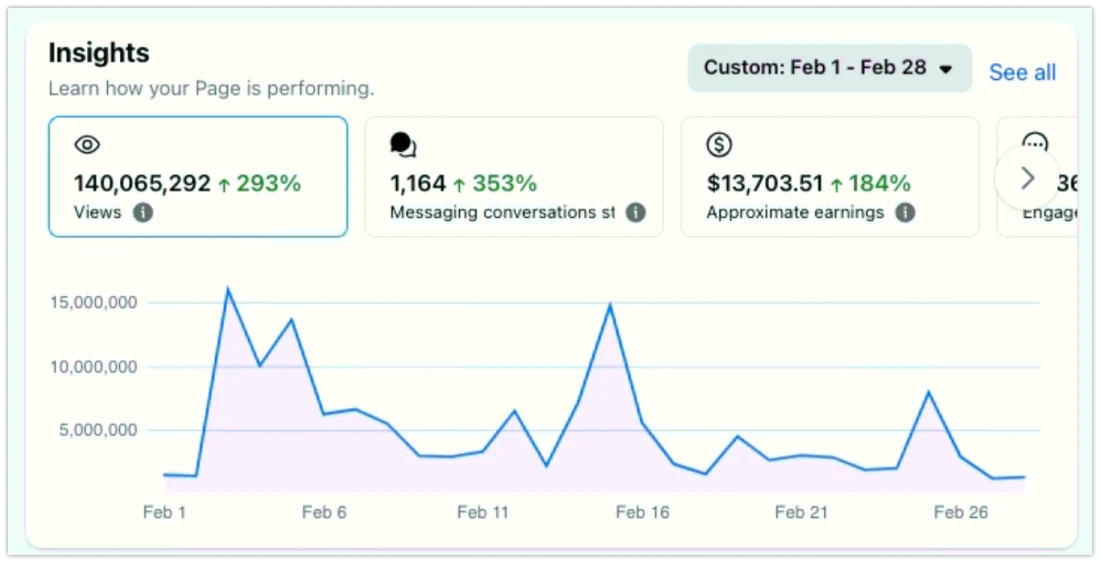
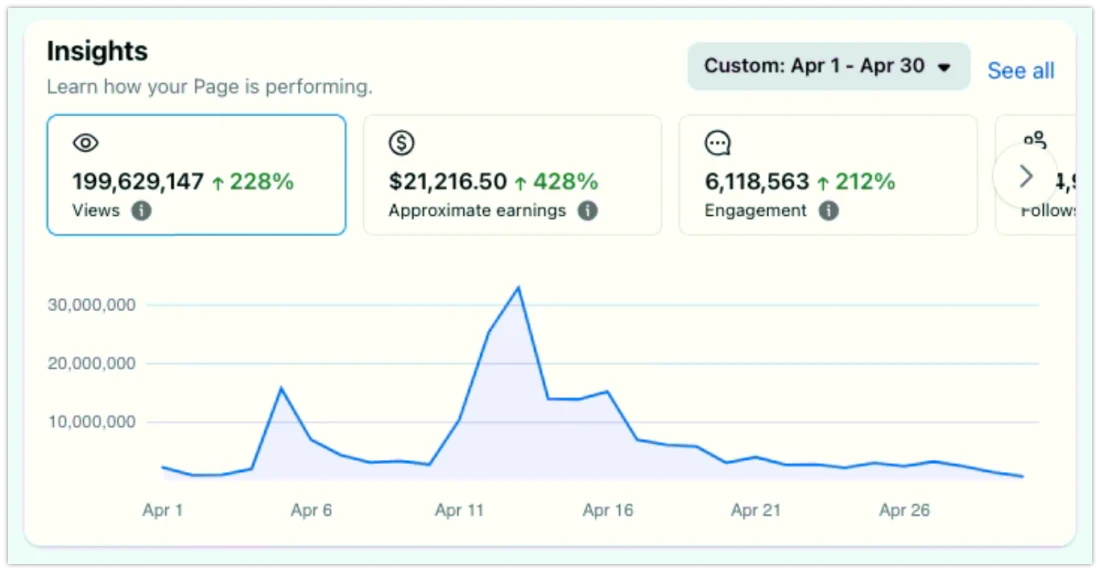
The network has run since 2016 and reaches over 25 million people. These are our own dashboard exports, not estimates. The two best page-months: $21,216 on 91.5 million qualified views and $13,703 on 58.8 million. The best single day: $4,163 on 12.8 million views; the best single post: $409 on 28 million views. Per thousand qualified views — the ones Meta counts — the rate runs from $0.08 to $0.33.
Two dashboard screenshots — two different pages of the network, February and April. Page names hidden, amounts and dates untouched. 140M views paid $13,703 and 199M paid $21,216: about ten cents per thousand views. This is a measurement, not a promise — the rate transfers, the totals do not.
Qualified views per month
At the network low
At the average
At the network high
1 000 000
≈ $80
≈ $185
≈ $220
10 000 000
≈ $800
≈ $1 850
≈ $2 200
90 000 000
≈ $7 200
≈ $16 650
≈ $19 800
The network runs about 250 pages in 25 languages. Across the monetized pages the average is $0.024 per thousand views, and $0.08 to $0.33 per thousand qualified views — the ones Meta counts, averaging $0.185. The best single page-month was $21,216 and the best day $4,163. These are measurements, not a promise: the rate follows language, market and format. Full breakdown in RPM by country.
How we help
If the niche is chosen and the money is not there because of the market, the topic has nothing to do with it and is not what needs changing. We let a video go out on network pages with revenue sharing, or we build a page turnkey for the audience language you need.
Your videos and photos go out on the network's pages and we split the revenue. The invitation, the eligible country and the payout account stop being your problem — the pages and the payouts are on us. We pick the language and the market that fit your content, and we check every file for originality risk before it is published. The rights to your material stay with you.
You monetize on your own page and we set it up. If you would rather own the asset and keep all of the revenue, we prepare the page, help with the payout details and hand over a plan of what to publish and when.
Write to us with a link to your channel or page: we will say which languages your material makes sense in and roughly what it would return.
I have an idea for a channel but the niche looks taken. Is it worth starting?
October 2026
Taken is usually good news: demand in that topic has already been proven with someone else’s money, so you do not have to establish that it exists. Check something else instead: are there channels under a year old in that topic that are growing? If there are, the door is open. If everyone growing is three years old or more, you are entering an accumulated audience rather than a niche. And separately, work out whether you will make a hundred videos in that topic, not ten.
My niche runs on AI images. Will I get monetization or be called slop?
October 2026
They look at what you added, not at whether AI was involved. If the video cannot be told apart from a hundred others made the same way, it gets caught — and the issue will not be the AI but the absence of anything of yours. If AI is a tool inside your own work, questions usually do not arise. Test yourself like this: what in your video could not be reproduced by someone with the same prompt?
Sources: That Facebook treats first publication with the rights as the original, that duplicating what is already published counts as a violation, and that review looks at the contribution made — Meta Business Help Centre. The tournament character of distribution inside a topic is our own network observation, not a Meta statement. Language rates from $0.014 to $0.163, the 53-times gap, the $0.08–0.33 range and the $0.185 average — our own measurements across a network of roughly 250 pages in 25 languages. We do not measure rates by topic, and the text says so. Checked 15 October 2026.