Channel demonetized: what happens to your other channels on the same AdSense
Updated 15.10.2026 · Kostas Obuchow
One AdSense account per person means one channel's fall reaches the others. What actually links accounts according to the help centres, what is known only from creator reports, and why Facebook has no such link — but has its own, through the business portfolio.
Short answer
Yes, there is a link, and it runs through the person rather than the channel. AdSense identifies a human being: one person, one account, with all of your channels attached to it. That is why one channel’s problem stops being one channel’s problem.
Three levels, and they are not equally certain:
the AdSense account is disabled — monetization ends for everything attached to it. That consequence is direct and undisputed;
the channel is terminated (not demonetized but closed for violations) — under YouTube’s policies the person is then not allowed to own other channels or create new ones;
the channel is demonetized but not closed — this is where the ground gets soft. Creators describe it from the emails they receive; the help centres do not state it outright. There is a separate section on this below, and we are not going to pretend we know more than we do.
Facebook has no first level at all: AdSense plays no part there, and payouts run through the page’s own rail. It does have its own link, though — the business portfolio, which since 14 October 2026 pulls people in automatically.
What actually links accounts
It helps to separate three things that conversations collapse into the single word “link”.
The payment account. AdSense is tied to a person: name, address, tax details. Many channels attach to it, and earnings arrive in one payment against one threshold. Covered in two channels on one AdSense. The flip side of the same coin: if the account is disabled, everything attached to it stops, including channels that broke nothing.
Admission to the programme. This belongs to the channel, not the person. Each channel clears the thresholds itself and is reviewed itself. A monetized channel therefore hands a new one nothing except the payment plumbing.
The person’s standing. The least obvious level. Terminating a channel for community-guideline violations is a decision about the human being, and it restricts their right to hold other channels. Here YouTube is not looking at the payment account but at who stands behind it.
The three levels do not coincide. You can lose a channel’s monetization and keep AdSense. You can lose AdSense and keep the channels — without money. And you can lose the right to channels at all.
Where the verifiable part ends
Now the honest section this piece was written for.
Open creator discussions are full of one scenario: a channel is demonetized, the person starts a new one, and the new one will not take monetization until the first is restored. Creators point to wording in the email that arrives after monetization is removed. Some treated it as a rumour for years and then met it themselves.
We could not find that wording in the documentation. Neither YouTube’s nor AdSense’s help centre states outright that demonetizing one channel blocks monetization on the same person’s other channels until the first is restored.
Two conclusions follow, and both are practical:
you cannot build a strategy on the assumption that no link exists. The reports are too numerous, too consistent, and come from people with very different histories;
you cannot build one on the assumption that it works exactly that way either. An unverified mechanism is a poor basis for a decision that can cost you an account already paying out.
The only reliable conclusion is this: one channel’s fall is a risk to everything attached to the same person, and you do not know the size of that risk. That is precisely why cautious operators do not keep everything inside a single link.
Why an entire industry grew around this
Antidetect browsers, proxies, a separate payment account per channel, bought accounts — none of this exists for its own sake. It is an answer to one fear: that one channel’s fall will drag the rest.
We cover it as a phenomenon rather than a how-to, and we will not recommend it, for a simple reason: it tries to solve a question of platform trust by defeating the platform’s identification. If the identification works, you lose not one channel but the whole cluster at once — exactly what you were protecting yourself against. The risk does not shrink; it concentrates.
Genuinely untangling the risk looks different and duller: not one person holding eight channels inside one link, but different platforms with different payment rails.
Facebook has no such link
Here the mechanism is built differently, and that is architecture rather than a marketing claim.
AdSense plays no part in Facebook monetization at all. Content Monetization pays through a payment account attached to the page itself and to the business portfolio. There is simply no shared per-person payment account through which one problem drags everything else.
The concrete consequences:
removing monetization from one page does not halt payouts on the others. They run on their own rails;
there are no Partner Programme thresholds to clear again. No 1,000 subscribers, no 4,000 hours. That does not mean there are no requirements at all: Meta does not publish numerical thresholds, but it shows them to some creators inside the dashboard, and the sets differ — for example “10,000 followers, 150,000 views in 28 days, 3 reels in 90 days”. Meeting them puts you on the waitlist and guarantees nothing; covered in how to get Facebook monetization;
a refusal does not follow the person automatically. It stays a property of the page and its content.
And straight away, what not to conclude: that Facebook does not ban. It does, in waves. Across our network 58 pages currently have monetization removed — that is an aggregate, and it is more honest than any promise.
It has its own, through the portfolio
The risk does not vanish when you move; it changes shape. On Facebook what links things is not a payment account but access.
A business portfolio is a container holding pages and people. And here something happened that many missed: 14 October 2026 was the deadline, after which everyone who has ever had access to your pages is added to your portfolio automatically, with basic access. Anyone who did not clean the list beforehand will now find all of them there — including people who needed access once, two years ago. Covered in Meta’s business portfolio.
The difference from AdSense is fundamental, and it works in your favour:
YouTube and AdSense
Facebook and the portfolio
What links
the person’s payment account
people’s access to pages
Can it be untangled by hand
no, one account per person
yes, in the People settings
What stops when there is trouble
payouts across everything attached
at worst, the pages of one portfolio
So on Facebook the link is manageable. That does not mean you can ignore it: a network gathered into a single portfolio widens the blast radius under review. It means a remedy exists, and it lives in the settings rather than in an antidetect browser.
What this is worth in money
Untangling risk is half the argument. The other half is why you would move a library to another platform at all.
A Facebook rate is set by the audience’s market, and the spread is wide. Across our pages the gap between the cheapest and the most expensive audience language is 53 times over: the open part runs from Russian at $0.014 per thousand to German at $0.163. Our measured rate on qualified views is $0.08 to $0.33 per thousand, averaging $0.185.
That is a measurement, not a promise: the figures come from our own network of roughly 250 pages in 25 languages, built since 2016, and yours will differ. But the order of magnitude is set by language and market rather than by effort — and that lever is out of reach for a solo creator while a network has it.
EXPERIENCE AND FIGURES
≈250pages in the network
25languages
$21 216best month on one page
$4 163best day on one page
$409best single post
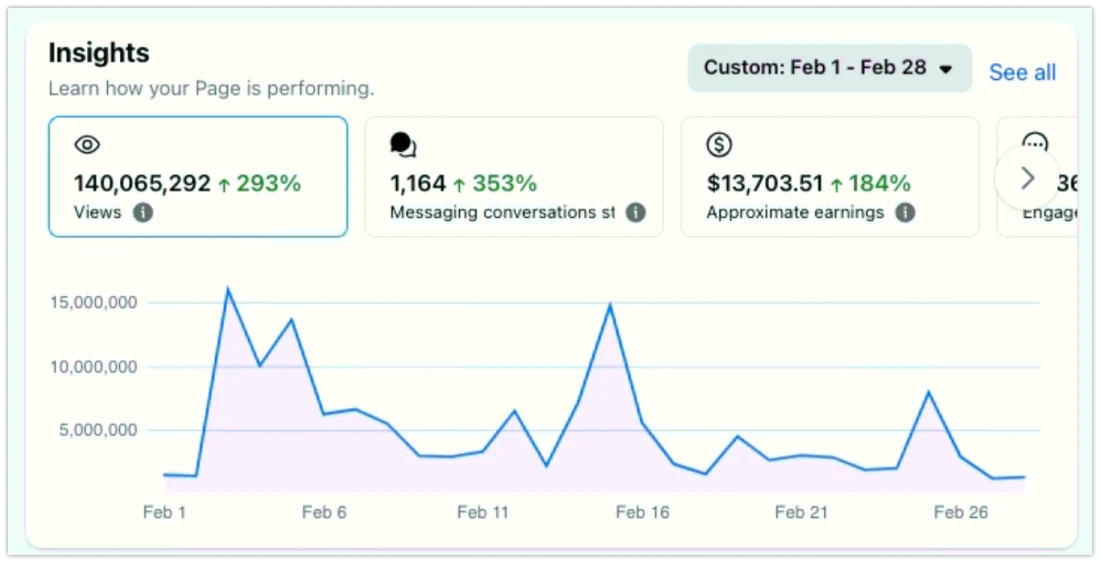
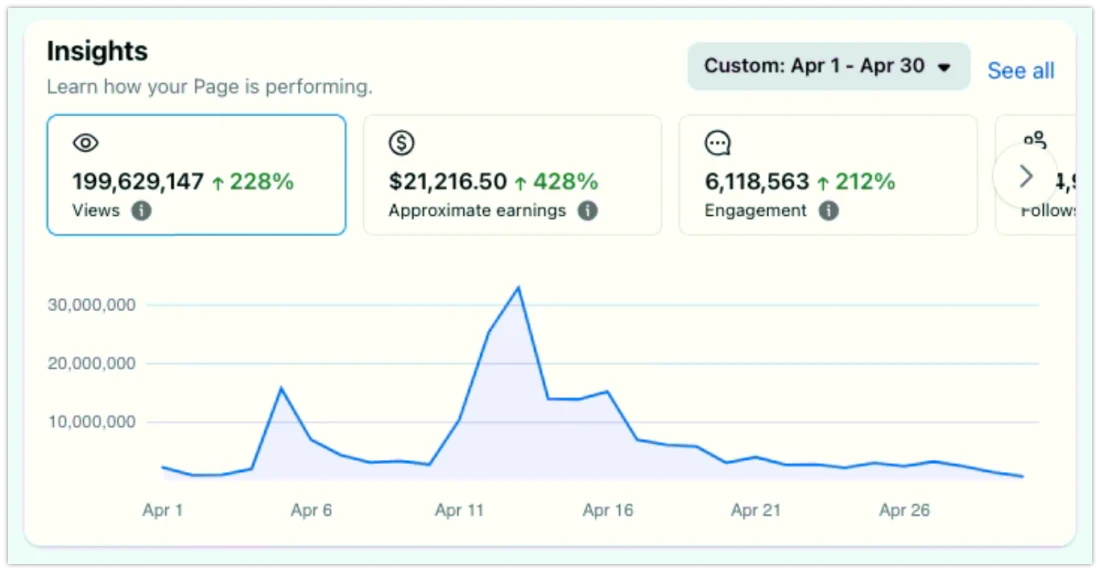
The network has run since 2016 and reaches over 25 million people. These are our own dashboard exports, not estimates. The two best page-months: $21,216 on 91.5 million qualified views and $13,703 on 58.8 million. The best single day: $4,163 on 12.8 million views; the best single post: $409 on 28 million views. Per thousand qualified views — the ones Meta counts — the rate runs from $0.08 to $0.33.
Two dashboard screenshots — two different pages of the network, February and April. Page names hidden, amounts and dates untouched. 140M views paid $13,703 and 199M paid $21,216: about ten cents per thousand views. This is a measurement, not a promise — the rate transfers, the totals do not.
Qualified views per month
At the network low
At the average
At the network high
1 000 000
≈ $80
≈ $185
≈ $220
10 000 000
≈ $800
≈ $1 850
≈ $2 200
90 000 000
≈ $7 200
≈ $16 650
≈ $19 800
The network runs about 250 pages in 25 languages. Across the monetized pages the average is $0.024 per thousand views, and $0.08 to $0.33 per thousand qualified views — the ones Meta counts, averaging $0.185. The best single page-month was $21,216 and the best day $4,163. These are measurements, not a promise: the rate follows language, market and format. Full breakdown in RPM by country.
How we help
If you are building a second platform so as not to keep everything inside one link, the decision that matters is not the tool but whose rail the page sits on. We let a video go out on network pages with revenue sharing, or we build a page turnkey — on your portfolio and with your access.
Your videos and photos go out on the network's pages and we split the revenue. The invitation, the eligible country and the payout account stop being your problem — the pages and the payouts are on us. We pick the language and the market that fit your content, and we check every file for originality risk before it is published. The rights to your material stay with you.
You monetize on your own page and we set it up. If you would rather own the asset and keep all of the revenue, we prepare the page, help with the payout details and hand over a plan of what to publish and when.
Write to us with a link to your channel or page: we will say which languages your material makes sense in and roughly what it would return.
My channel was demonetized. If I start a new one on the same account, will it get monetization?
October 2026
Honestly: nobody can tell you for certain, and that is the main thing worth knowing. The documentation contains no outright ban on monetizing another channel after the first loses monetization, yet creators describe exactly that outcome in numbers and point to the email. What is certain: if the AdSense account itself is disabled, everything attached stops; if the channel was terminated for violations, the right to hold channels at all is restricted. So I would not build a money decision on this in either direction.
Is Facebook the same? If one page gets banned, will the others fall?
October 2026
No, not through a payment account — there isn’t one there; payouts run on the page’s own rail. But Facebook has its own link, through the business portfolio: pages and people sit in one container, and after 14 October 2026 everyone who had access is added to the portfolio automatically. The difference is that this can be managed by hand in the People settings, whereas one AdSense account per person cannot be untangled at all.
Sources: That one person may hold one AdSense account and attach several channels to it, that disabling the account ends monetization for everything attached, that Partner Programme thresholds and review apply per channel, and that terminating a channel for violations restricts the right to own other channels — Google AdSense Help and YouTube Help. No statement that demonetizing one channel blocks monetization on the same person’s other channels until the first is restored appears in the documentation; that scenario is known from creator reports in open discussions and is marked as such in the text. That Content Monetization arrives by invitation and pays through the page’s payment rail, and the automatic addition of people to a business portfolio after 14 October 2026 — Meta Business Help Centre. Language rates from $0.014 to $0.163, the 53-times gap, the $0.08–0.33 range and the $0.185 average — our own measurements across a network of roughly 250 pages. 58 pages with monetization removed — our own network aggregate. Checked 15 October 2026.