Content monetization services: what they can do, what they cannot, and what to ask before paying
Updated 18.10.2026 · Kostas Obuchow
A content monetization service sells one of three things: access, distribution, or advice. Only the first two are scarce, and nobody can sell you a Facebook invitation faster than Meta issues it. What each kind actually delivers, what the rate depends on, and the questions that separate an operator from a reseller.
In short
A service can sell you access or distribution. It cannot sell you a decision Meta has not made.
People searching for a content monetization service or platform usually want one of three different things, and the word covers all three: getting into a monetization programme, getting their existing videos in front of a paying audience, or being told what to do. The first two are genuinely scarce. The third is widely available and worth much less than it is priced at.
The honest boundary runs here: Facebook’s Content Monetization is invitation-only. There is no application form, so there is no process anyone can walk you through and no queue anyone can move you up. Anybody who offers to speed up your invitation is selling something they do not have.
What can be sold legitimately: a page that already holds the invitation, or distribution on pages that already hold it.
Three kinds of service
Access. Someone transfers a page that already has monetization enabled, with the setup done in your name. This is a real object with a real owner — it exists before the money changes hands and it can be checked before you pay. Ask to see the dashboard.
Distribution. Your finished videos go out on someone else’s monetized pages and the revenue is split. You keep producing, they keep the platform running. This costs the creator nothing up front, which is also what makes it the easiest offer to make badly: the whole value sits in how many pages there are and in what languages.
Advice. Courses, audits, “strategy”. A good one saves you months on the craft — niche selection, finding what already worked, batch production. None of it affects the two things that actually gate the money: whether you are invited, and what your audience’s language pays.
Services mix these three and price them as one. Separate them before you compare prices, or you will be comparing a page to a PDF.
What no service can do
Make the invitation arrive. It comes in waves and is not sorted by page size. In August 2026 approvals went to pages with 400 followers in the same month refusals went to pages with 447,000 followers and 6 million views a month. There is no threshold to cross.
Change what your market pays. The rate follows the language and country of the audience, not the quality of the work. Across our own pages the gap between the cheapest and the most expensive language reaches 53 times. No service changes that for a given audience — it can only put your work in front of a different one.
Move your financial accounts. The programme requires your payment accounts to be in an eligible country, not just you. No amount of setup work changes a jurisdiction.
Guarantee income. Anyone who does is either guessing or lying. What transfers between pages is a rate, not a sum.
Five questions before you pay
What exactly am I buying — access, distribution, or advice? If the answer mixes them, ask for the price of each separately.
Can I see the dashboard of the page before I pay? For access, this is the whole object of the sale. A screenshot of someone else’s dashboard is not an answer.
What happens if the page is restricted after transfer? The honest answer is usually “nothing” — there is no replacement. Know it before, not after.
On distribution: how many pages, in which languages, and who posts? The language is the lever. “A big network” without languages is a number without meaning.
What measurements are these numbers from, and over what period? A rate quoted without a sample size and a month is a marketing figure, not a measurement.
A service that answers all five plainly may still be wrong for you. One that cannot answer them is wrong for everyone.
What it comes to in money
The honest frame first: these are our own measurements, not a promise.
What we measured
Value
Rate per thousand qualified views
$0.08 to $0.33, averaging $0.185
Best month on a single page
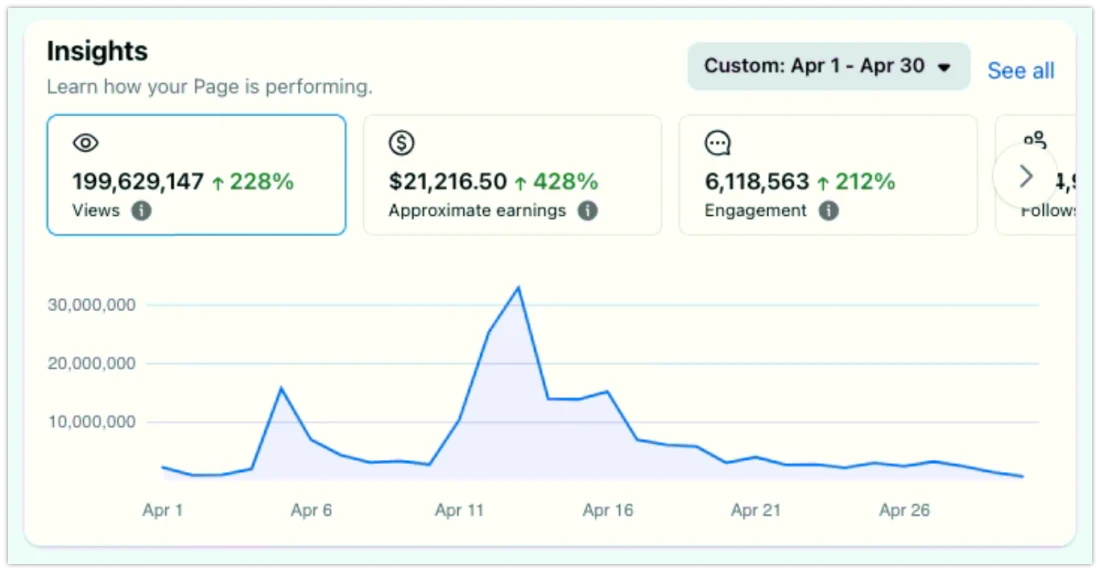
$21,216 on 91.5M qualified views
Second best month
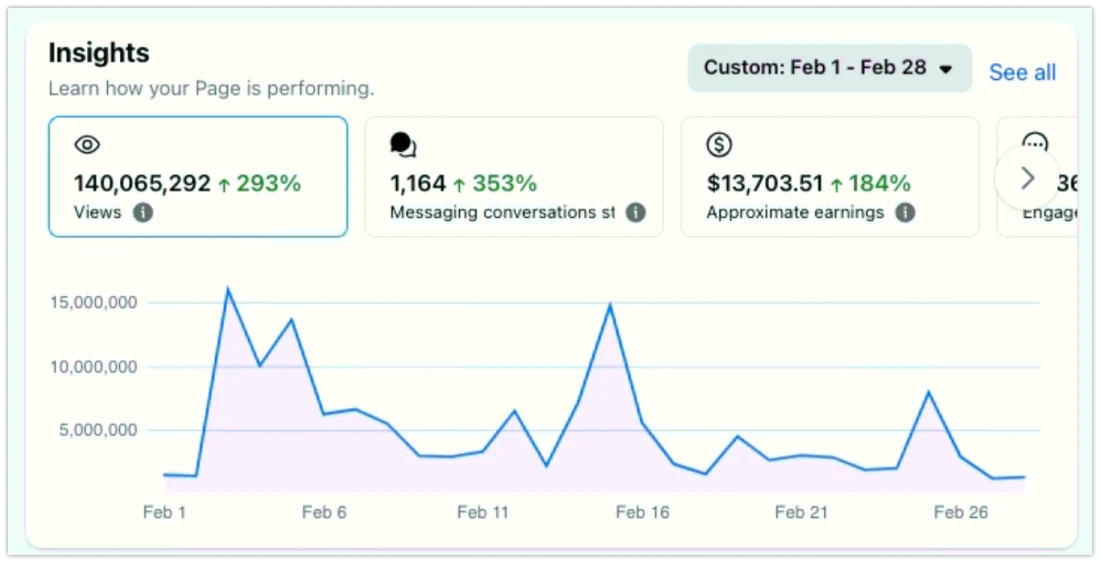
$13,703 on 58.8M
Gap between the cheapest and most expensive audience language
53 times
EXPERIENCE AND FIGURES
≈250pages in the network
25languages
$21 216best month on one page
$4 163best day on one page
$409best single post
The network has run since 2016 and reaches over 25 million people. These are our own dashboard exports, not estimates. The two best page-months: $21,216 on 91.5 million qualified views and $13,703 on 58.8 million. The best single day: $4,163 on 12.8 million views; the best single post: $409 on 28 million views. Per thousand qualified views — the ones Meta counts — the rate runs from $0.08 to $0.33.
Two dashboard screenshots — two different pages of the network, February and April. Page names hidden, amounts and dates untouched. 140M views paid $13,703 and 199M paid $21,216: about ten cents per thousand views. This is a measurement, not a promise — the rate transfers, the totals do not.
Two things that make this table read correctly. The ceiling figure was produced by a page with a hundred million views a month and ten years behind it — it is not a normal month. And the number that transfers to you is the rate: take your own monthly views and multiply.
What we do
How we help
We are the operator, not a reseller: the pages we talk about are our own, and the numbers above come from our own dashboard exports.
Your videos and photos go out on the network's pages and we split the revenue. The invitation, the eligible country and the payout account stop being your problem — the pages and the payouts are on us. We pick the language and the market that fit your content, and we check every file for originality risk before it is published. The rights to your material stay with you.
You monetize on your own page and we set it up. If you would rather own the asset and keep all of the revenue, we prepare the page, help with the payout details and hand over a plan of what to publish and when.
Write to us with a link to your channel or page: we will say which languages your material makes sense in and roughly what it would return.
We have been running Facebook monetization since 2016: about 250 pages of our own, 25 languages. Which of the two routes fits comes down to two things — how many finished videos you have, and whether you want to run a page yourself.
We work with people who already have something running: income and a library. If there is no income yet, that is not a refusal — the answer is simply different, and it contains no paid products.
Nobody guarantees income, and we are not affiliated with Meta.
Questions from creators
Someone offers to get my page into Content Monetization for a fee. Is that possible at all?
October 2026
Getting your page in, no — the invitation is Meta’s decision and there is no form to submit or queue to jump. What can be sold is a page that already has the invitation, with the setup transferred to you. Those are different products at a similar price, and the difference is worth asking about before paying.
What is the difference between a monetization platform and a network of pages?
October 2026
Usually the words are used interchangeably, so ask what sits behind them. A network of pages is an object: pages, languages, who posts, whose accounts hold the monetization. A platform can mean the same thing or just a dashboard on top of someone else’s pages. The question that separates them: whose pages are these, and can I see one.
I have 600 videos. Is it better to sell them or to split the revenue?
October 2026
With a library that size, the revenue split usually wins: the material keeps earning instead of being paid for once, and it costs nothing to start. Your own page makes sense when you want an asset rather than a flow, and when you are willing to run it.